Databricks Data+AI Summit 2026: My Honest No-BS Takeaways

I was at the 2026 Databricks Data+AI Summit, attended the keynotes and a few talks, met with a lot of customers, and had many hallway conversations. These are my honest no-bs takeaways.
I’m going to focus on four things: the context layer, the bigger shift toward work, AI governance, and the open-source release that made me feel a lot better about my own browser-tab chaos.
1. Context: they boiled the ocean, and now they need a search engine
Databricks went deep on context and they’re doing it, supposedly, in a two- way hybrid approach (or at least that is how I’m seeing it).
The top-down approach is Unity Catalog.
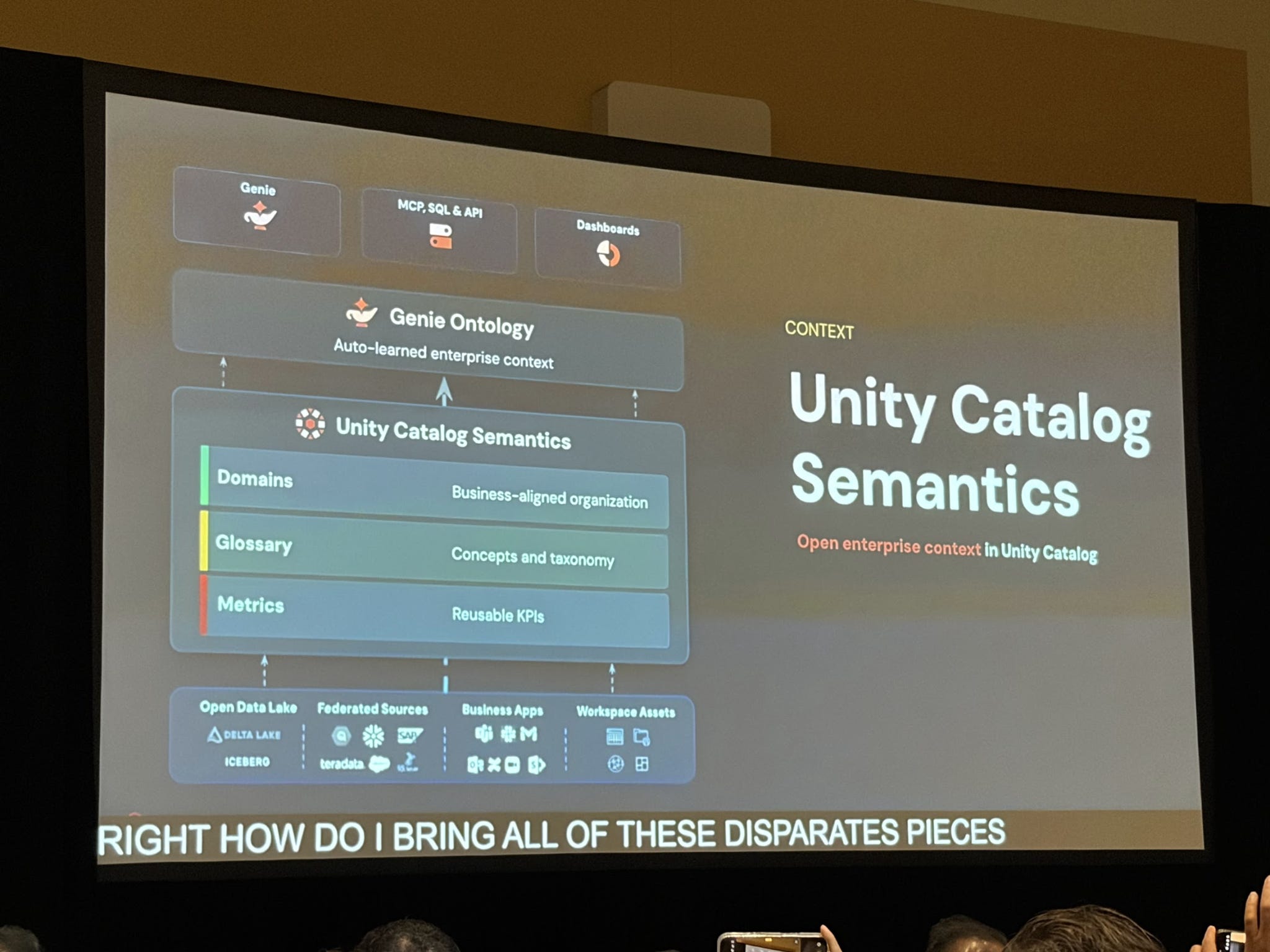
This is the deterministic side: humans defining metrics, building out glossaries, adding governance controls.
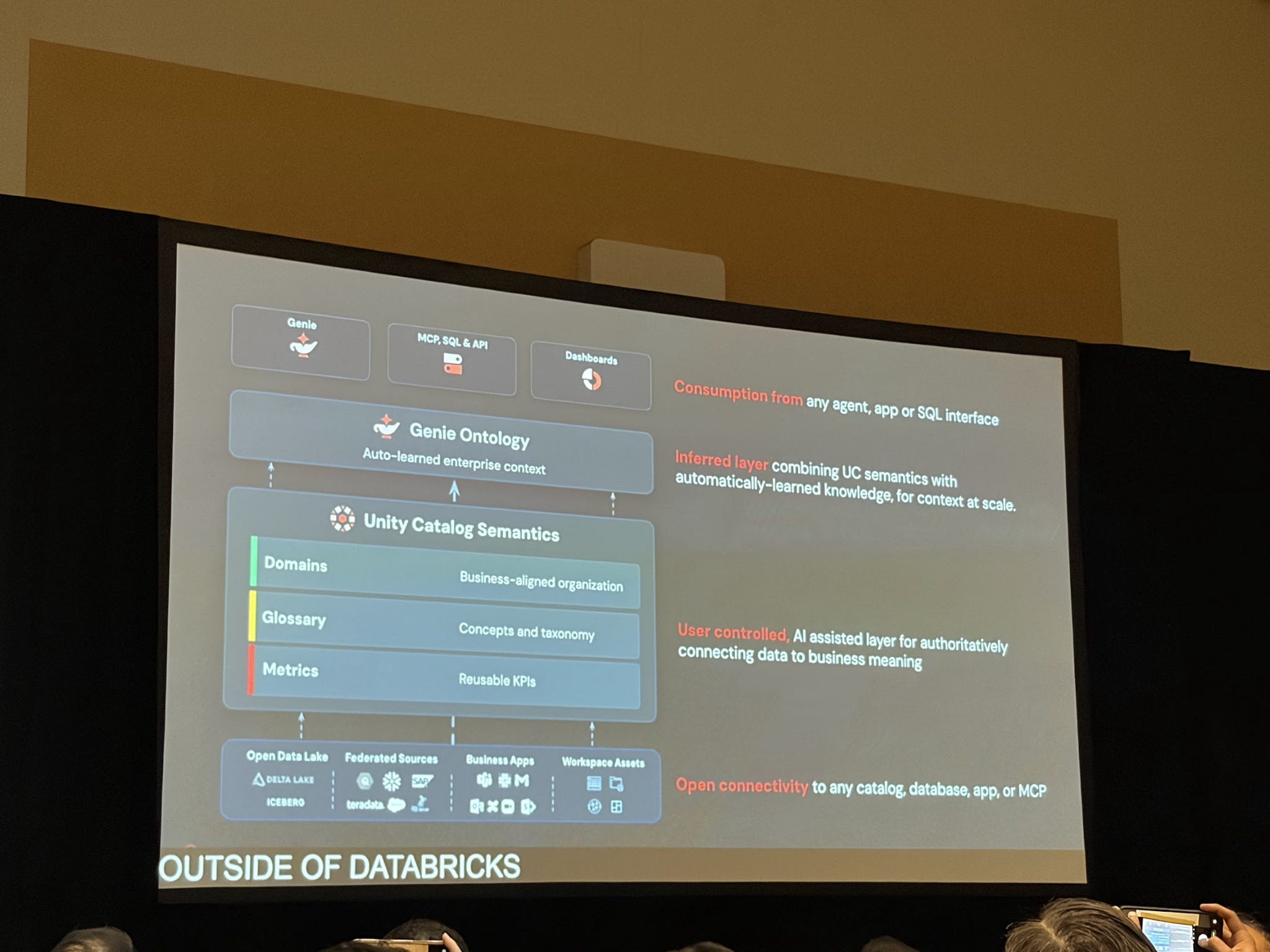
And it’s very clearly built for analytics. The new metric views, the glossary work, all of it is oriented around Genie getting better answers out of your fact-dimension star schema analytical data.
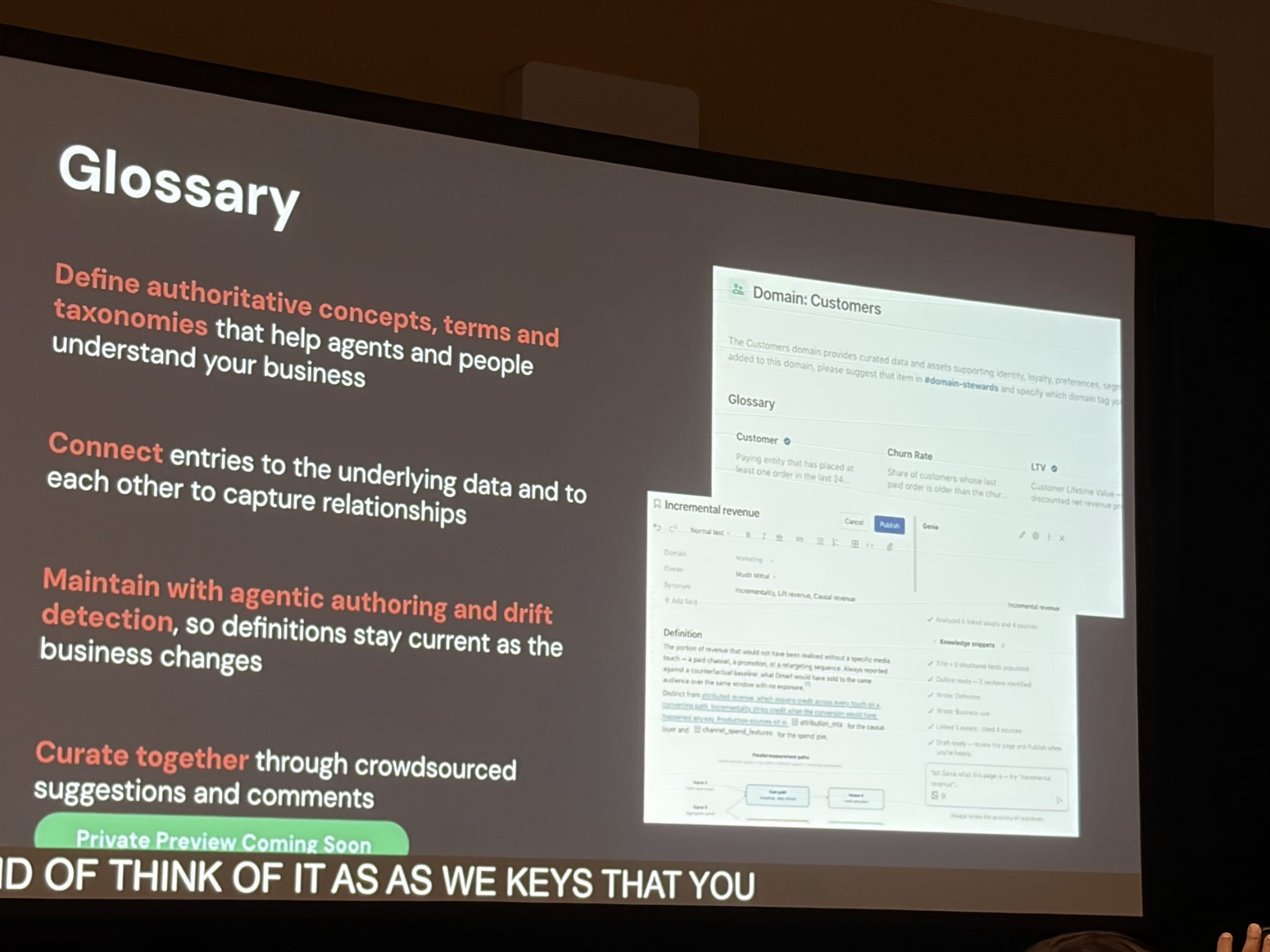
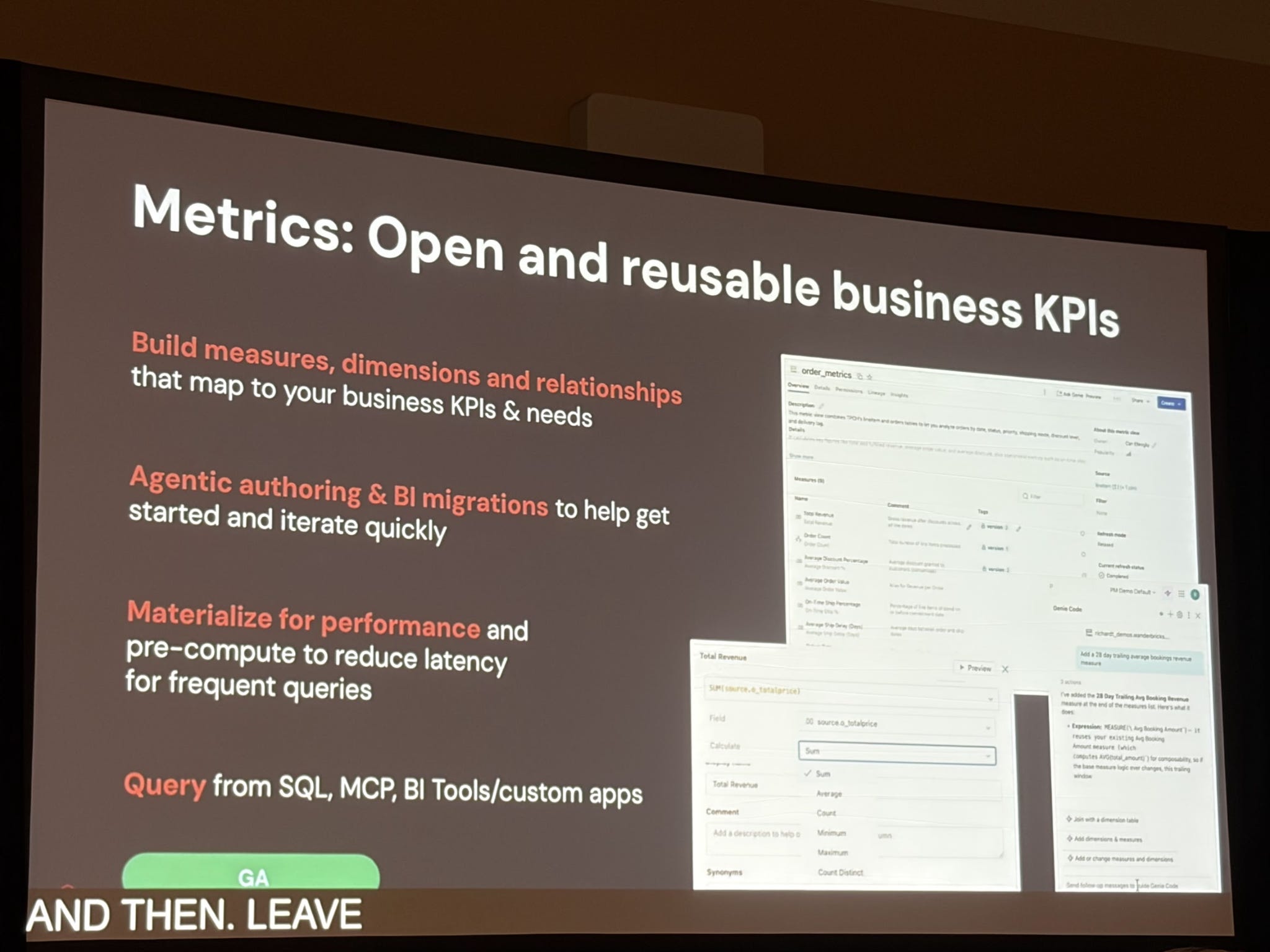
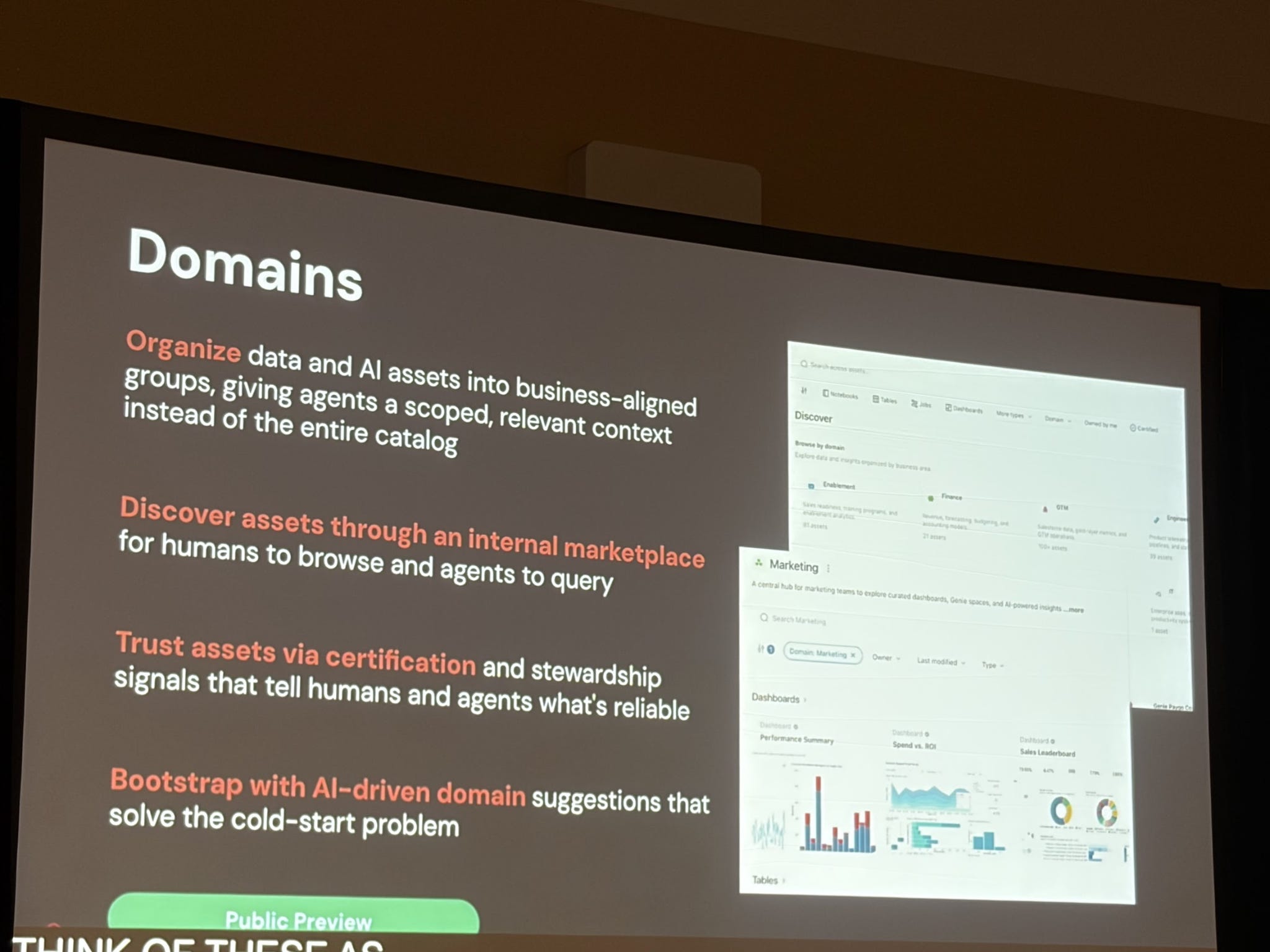
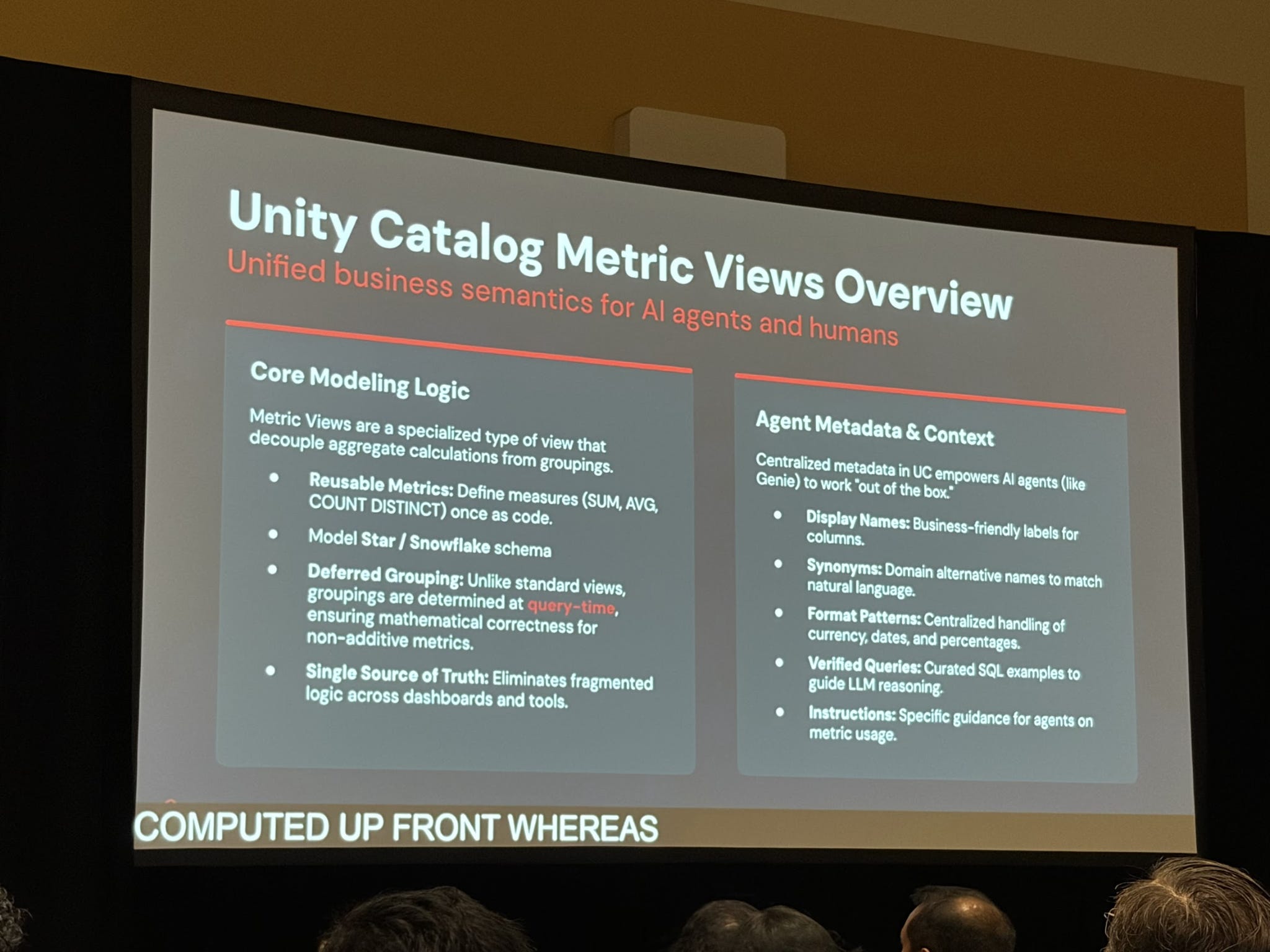
Databricks is tightly coupling the catalog to question-answering. That’s the coherent, well-scoped bet that basically every platform and context layer point solution is doing.
The bottom-up approach is the one everyone’s talking about: Genie Ontology.
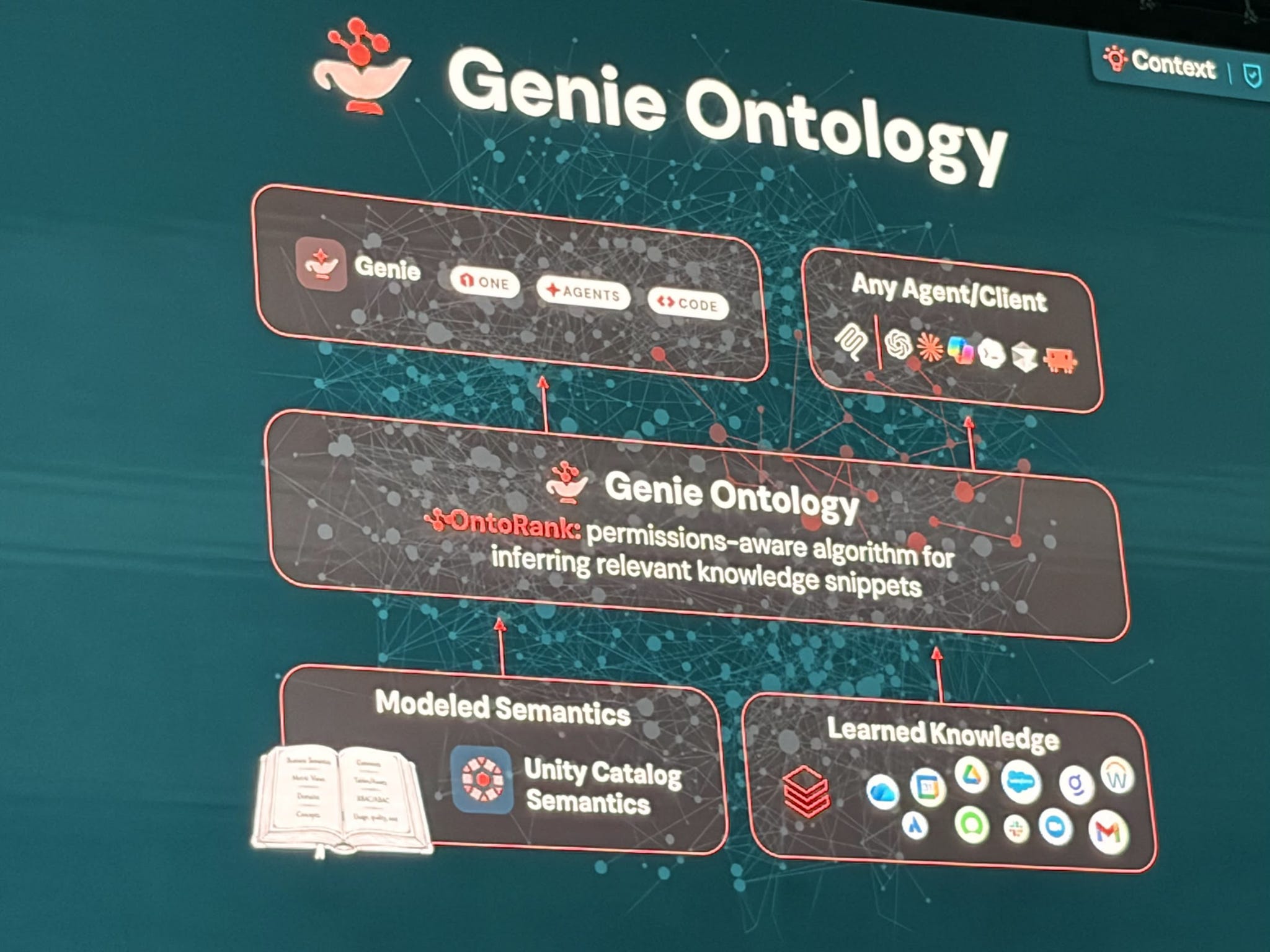
And the best way I can describe what they did is that they found a way to boil the ocean. They built a system that automatically indexes everything — documents, dashboards, code, notebooks, whatever it can connect to — and constructs an “ontology” (in quotes on purpose) out of it without asking a human to model anything first.
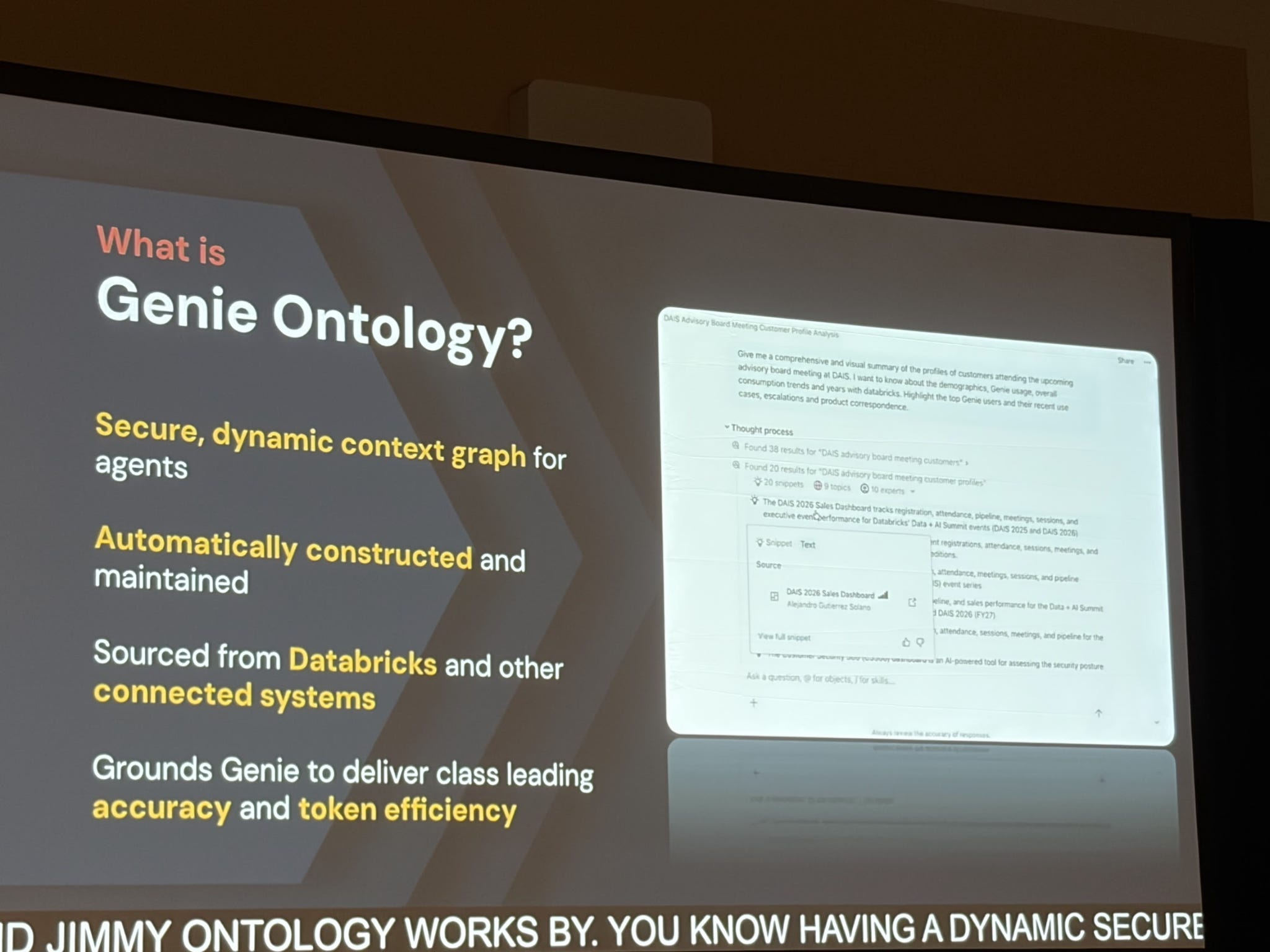
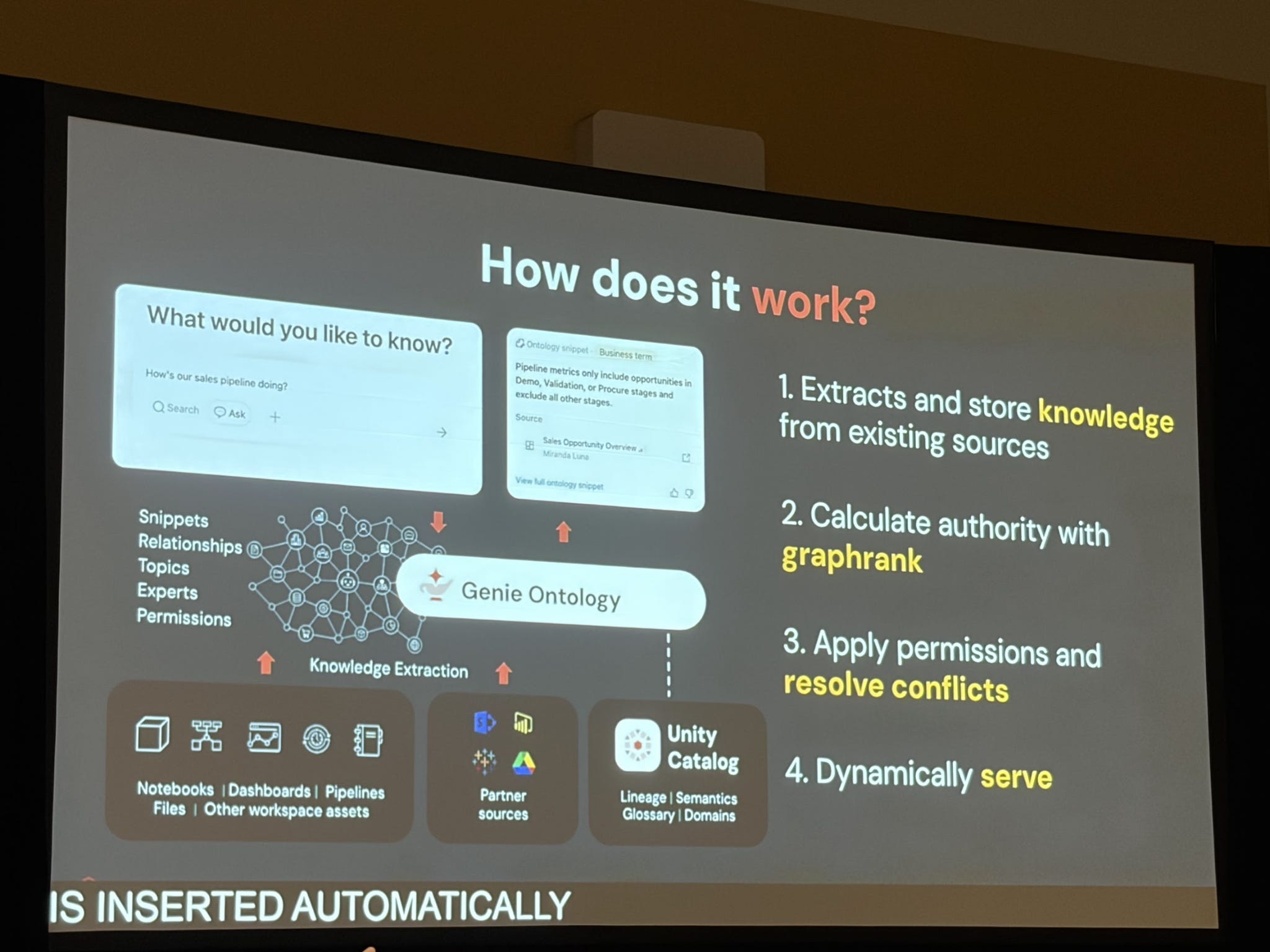
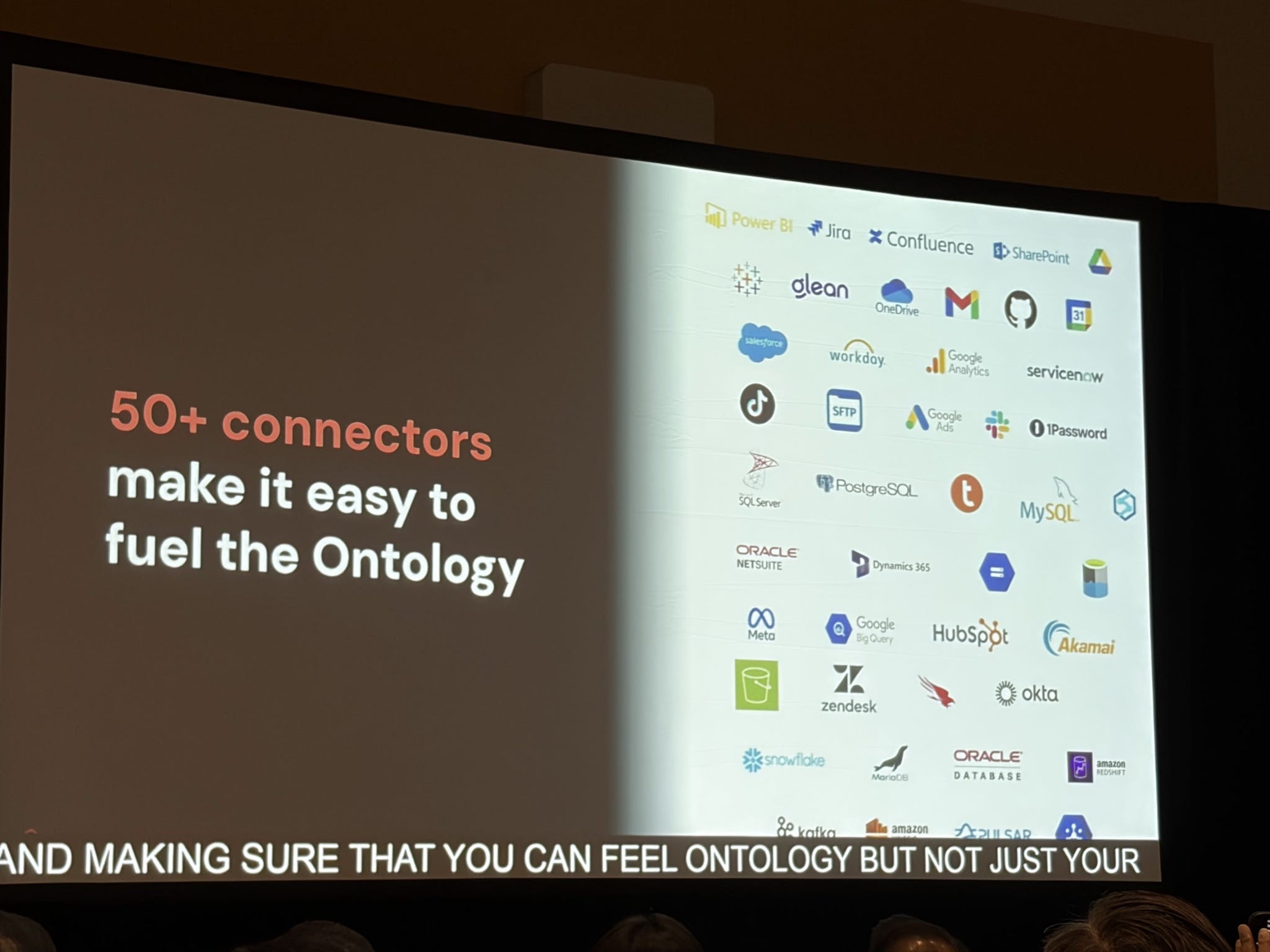
But here’s the thing about boiling the ocean: once you’ve done it, you have a new problem. You need to figure out what’s actually worth surfacing. That’s exactly the problem web search engines solved a couple decades ago when they indexed the entire web, and Databricks borrowed the same playbook. Their answer is OntoRank, a PageRank-style algorithm that ranks things by popularity.
And popularity is an interesting proxy. It is not the same thing as enterprise importance.
My honest no-bs read is that after talking to several customers who spoke with Databricks, this was a solution looking for a problem. Not in a dismissive way. It’s a genuinely clever piece of engineering, but I think Databricks needed a checkbox for “ontology” because the term has been gaining mindshare in data circles, and they hadn’t been playing in that space. So they built something fast, of course to provide context for AI, but now they’re figuring out the concrete use cases after the fact.
I’m also going to set aside the fact that they’re using the words “ontology” and “knowledge graph” pretty loosely relative to how those terms have been used for the last 20+ years. I don’t want to be pedantic about it. But it’s worth naming: this is fairly marketing-heavy. And I suspect part of the play is redefining what “ontology” means, rather than building toward the existing definition. I think all vendors are trying to do this. But oh well... pick your battles :)
What Databricks has done is that they lowered the barrier to entry. Automatically generating a starting point for your enterprise semantics is a real unlock for a problem that has historically been brutally manual. They have scaled knowledge engineering and knowledge acquisition, and the roles of knowledge engineer and what I’ve called the knowledge scientist. That matters.
What we have to be careful about is the vanity-metrics framing. They announced that they created 4.5 million ontology snippets internally. I don’t know what to do with that number. Am I supposed to be impressed? Is that good? Bad? Volume of generated context tells me nothing about whether the context is accurate, relevant, or governed. None of the size claims matter if the answer you get back is wrong.
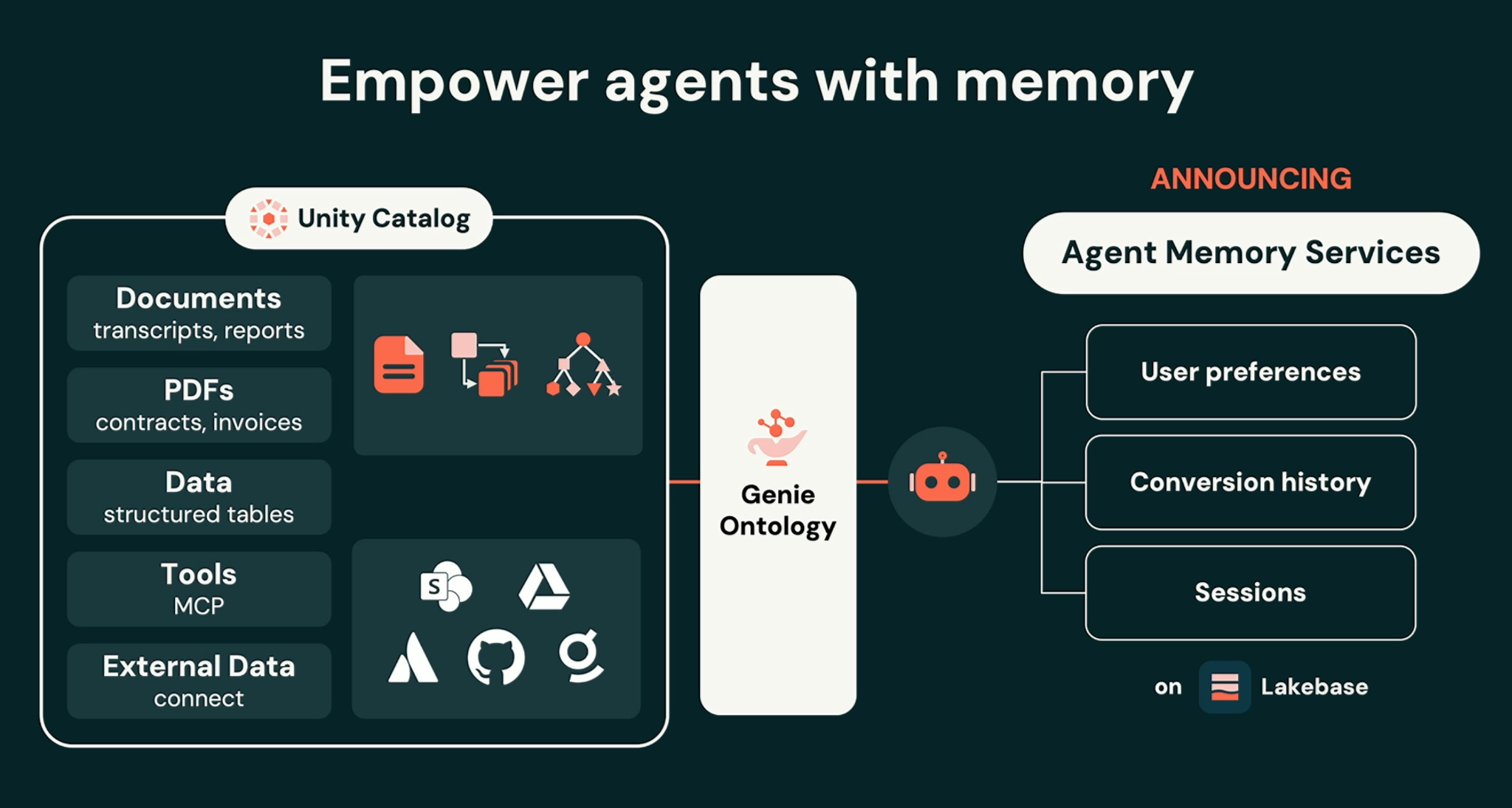
And that gets to the open question I keep coming back to: how do these two approaches, the deterministic top-down catalog and the automatically generated bottom-up “ontology”, actually meet in the middle? The catalog has governance. The ontology has scale. Right now it’s not clear to me where the human-in-the-loop governance actually attaches to the automatically generated layer. In the Unity Catalog Semantics architecture (picture above), the unity catalog semantics is an input to Genie Ontology. So what is governing Genie Ontology? That gap is the whole game.
This connects to something I’ve been writing about for a while: there are two distinct reasons organizations need semantics. One is semantics for AI agents: giving a model or an agent enough context to answer a question well. The other is semantics for the interoperability of systems: a shared foundation of meaning that lets different platforms, teams, and processes actually understand each other over time, independent of whichever AI happens to be asking.
Databricks is unambiguously building for the first one.
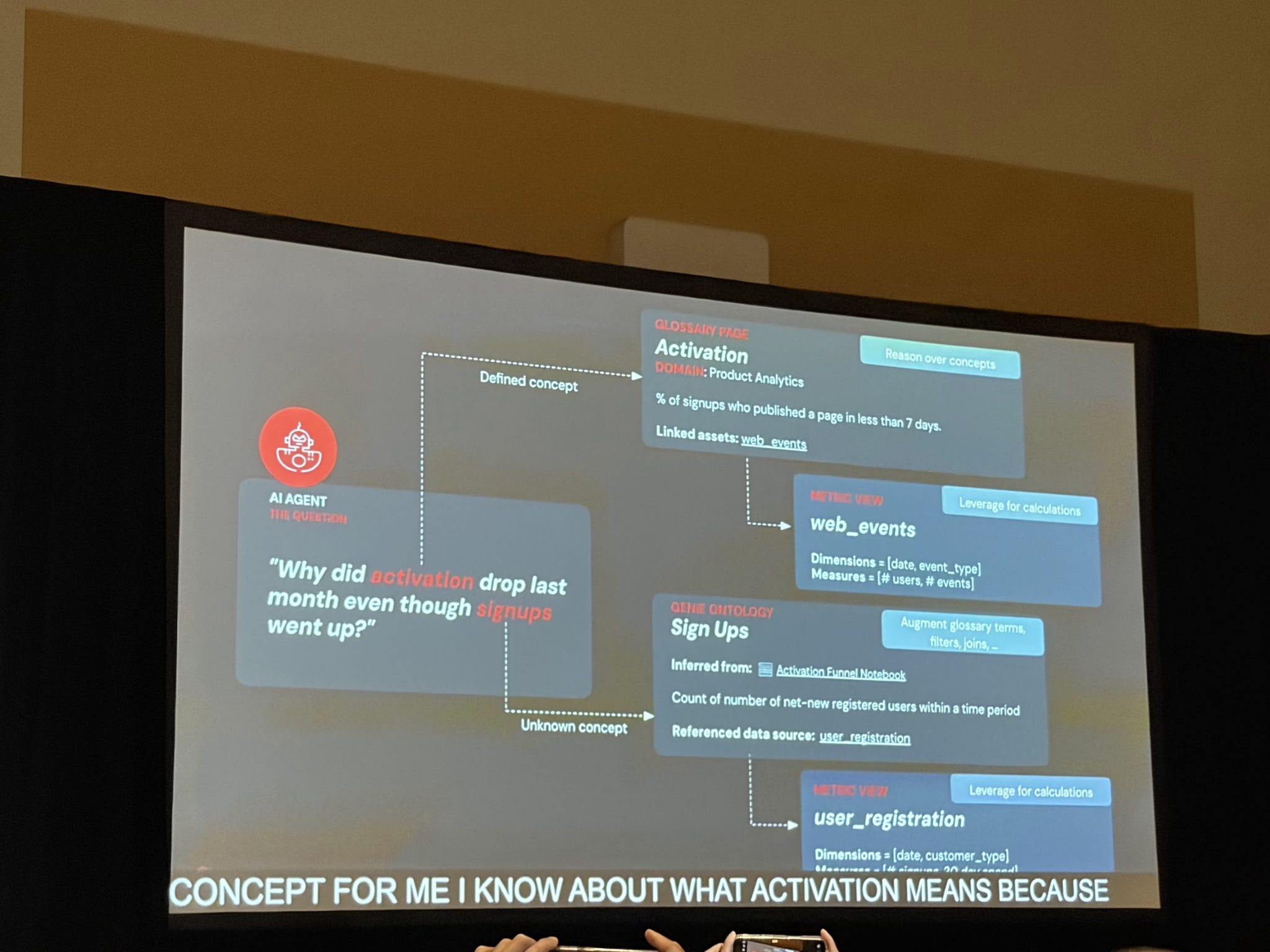
There is no real intention here toward semantic interoperability across systems and honestly, that’s consistent with their incentives. Their goal is to get all your data inside the Databricks ecosystem, in which case you don’t need interoperability between systems, because everything’s already one system. But that ambition runs into the same old problem that’s always existed: humans disagree about meaning, and that disagreement doesn’t disappear just because an algorithm generated a graph faster than a person could.
Zoom out and the bigger pattern is obvious: every platform right now wants to be the place where you manage context. Every single one. So the real question for any data leader isn’t “which vendor has the best ontology/context layer demo.” It’s: what are you actually optimizing for? If your honest answer is “we need this for AI because the board wants AI,” you’re going to reach for the fast, automatically-generated, quick-and-dirty option. I don’t think that’s where the long-term value lives. We’ve seen this story before: investing in big data and data science and not getting clear ROI from it. If your answer is that you want a durable semantic foundation that AI consumes as just one more system among many, that’s a fundamentally different, more strategic conversation, and it requires real organizational alignment.
And underneath all of it: governance. Governance is getting more complicated by the week, not less: data governance, AI governance, GRC, security, etc, and increasingly the connective tissue between them. Which means we need more automation in governance, not less, and this type of automation requires determinism. That’s where workflows come in. Wherever your context lives, you need a deterministic way to govern it, and that’s a workflow problem.
2. Work is the center, and everyone is finally heading there
This is the theme I’m most fired up about, because it’s something I’ve been arguing for a while and we’re now starting to see it show up across the entire industry.
We’ve been operating in a world that treats data as the center of the universe. Data is the new oil, be data-driven, build the data warehouse, build the lakehouse, build the analytics... and then we declare victory. But that’s backwards. Data is an enabler. Work is the center. Work is your processes: IT, HR, customer service, finance, whatever your business actually does. Context is an enabler for that work. Governance is an enabler. Analytics and insight are enablers. And AI and agents are simply the latest way work gets done.
Btw, my colleague Tim Gasper just wrote a piece on how governance is moving into the work that you should read.
This is exactly why the data and analytics field has struggled to prove ROI for so long. We built impressive infrastructure and called it done, without ever tracing the line back to the actual work it was supposed to improve. If the business doesn’t understand the value, it’s because we never connected what we built to the work itself.
I’ve talked before about a framework I keep coming back to: the triangle of convergence. One corner is your systems of record (CRM, ERP, HR, IT systems). Another corner is your systems of insight (data warehouses, lakehouses, analytics). The third corner is your systems of action (workflow and orchestration), what Gartner calls Business Orchestration and Automation Technologies (ServiceNow is a leader 😀). For a long time these have lived as three separate worlds, connected by integration.
What’s happening right now is convergence. Everyone is moving toward the center of that triangle at once. You can see it in how platforms that started in one corner are now reaching into the others.
And this is exactly why Databricks announced what they announced this year. The vertical apps, Lakewatch, a security product and CustomerLake, a customer data platform, are a tell. They’re not just trying to be the analytics layer anymore; they want you building your next system of record on top of their platform.
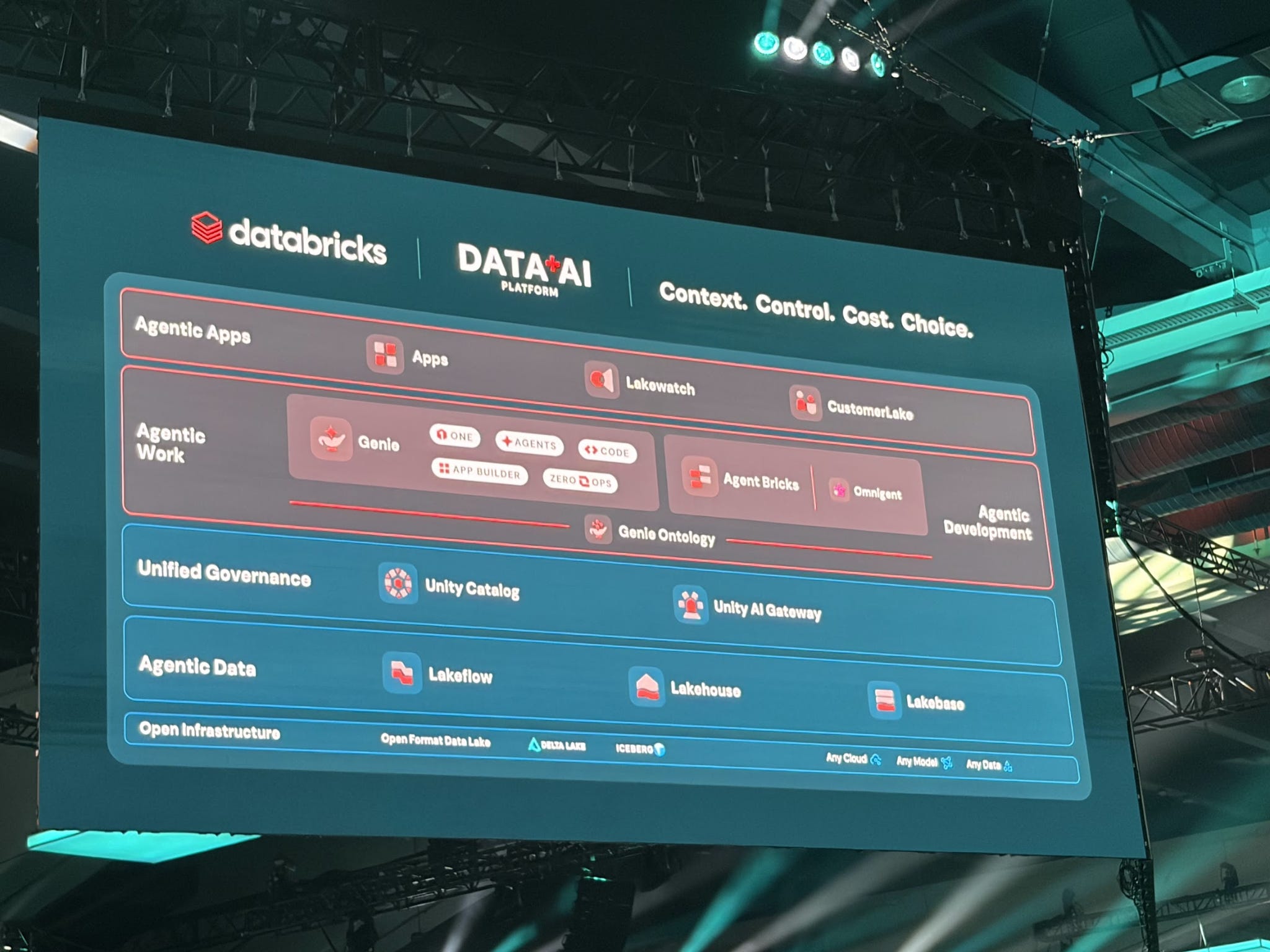
That’s why all the deep technical announcements mattered: LTAP, the new Reyden query engine, the Delta Lake and Iceberg convergence. Those aren’t separate stories. They’re the plumbing required to merge systems of record and systems of insight into one physical platform.
Choice was a big topic: no lock-in, open formats, any cloud, any model. And I think that’s real, but I’d push on where the choice actually lives. It’s a choice at the technical layer. The moment your business logic, your semantics, and your context get built on top of any one platform, you’ve made a much deeper commitment than your storage format. Open file formats don’t make your decisions reversible if everything else is coupled to one ecosystem.
So here’s the question I keep putting to people: what’s your center of gravity? Where does your data actually live? Where do your use cases actually live? Where does work actually get done today? And just as importantly, who are you already invested in, and who do you want to invest more in?
This matters more right now because the market is consolidating fast. If your strategy depends on a constellation of best-of-breed point solutions, ask yourself what happens when one of them gets acquired by a vendor you have no relationship with. I’m seeing more customers get genuinely thoughtful about this. Not paranoid, just appropriately careful about concentration risk and backup plans.
The underlying signal is consistent everywhere you look, including from Databricks’ own CEO Ali Ghodsi opening the keynote: “AGI is here today. Just not at work.”
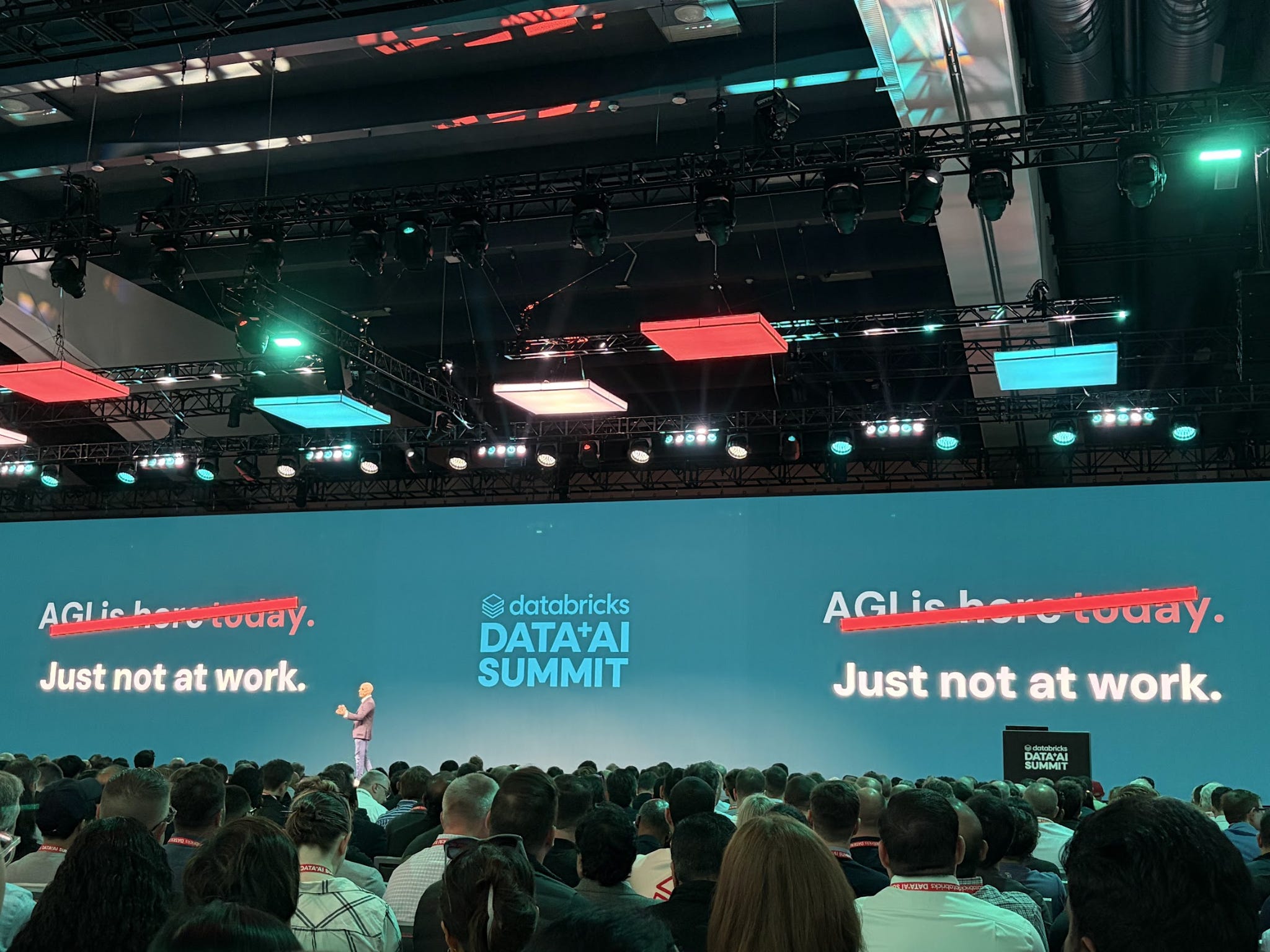
If you work in data, this is your cue: go understand how the business actually works, because that’s where this is all heading.
3. AI governance: it’s not just tracking anymore, it’s the budget
AI governance is having a moment, and it’s not subtle. Gartner just published a Magic Quadrant for it and a Magic Quadrant existing at all tells you something real: there’s a validated market, real buyers, and real urgency. (ServiceNow landed as a Leader 😀 )
What’s striking is the shape of the curve. Data governance interest has grown steadily for years, a slow, grinding climb. AI governance showed up and exploded almost overnight. Same underlying discipline, wildly different adoption curve.
Databricks announced Unity AI Gateway.
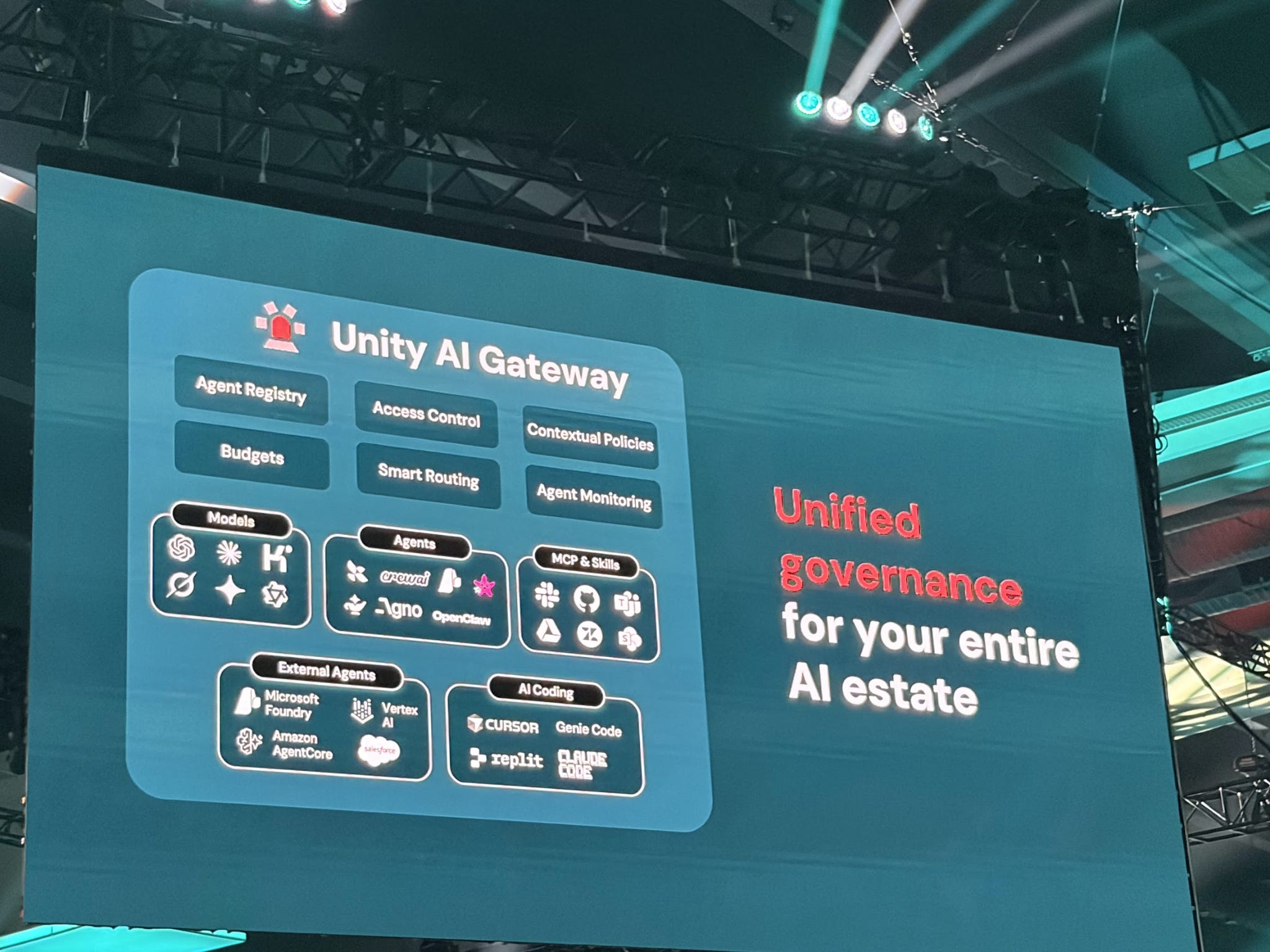
The part I found genuinely interesting wasn’t the tracking because every AI governance platform tracks agents and models now. It was the budget enforcement. Actually managing and enforcing spend limits. That’s exactly what’s keeping people up at night right now: the token-maxing problem, the unbounded cost curve of agentic workloads. It’s a very direct echo of the early cloud-computing days, when an entire category of tooling emerged just to manage and control cloud spend. We’re rediscovering that we should build cost controls in from day one instead of retrofitting them after the bill arrives.
But AI governance, done right, is much bigger than tracking AI agents plus budget. In Tim Gasper’s article “Governance is Moving into the Work” he talks about connected governance, which is the right framing. There’s data governance, AI governance, GRC, security, identity and all of it needs to connect. Every platform will tell you they integrate with the rest of your stack. The real question is how much of that is actually built versus aspirational. Every vendor is strongest at governing what happens inside their own walls. The harder, more valuable question is what’s happening outside those walls across your entire environment, not just one platform’s slice of it.
Nobody has this fully solved today, because the need is new. But it’s worth figuring out which vendors already have data governance, AI governance, GRC, security, and identity functioning together as connected disciplines, versus which ones are starting to assemble that picture now. That’s a materially different starting position.
One more open question I don’t have a clean answer to yet: everyone’s managing consumption-based AI spend right now. Is there a path from consumption pricing to something closer to value-based pricing where you’re tracking and paying for outcomes rather than tokens? I think that’s coming.
4. Omnigent: glad to know I’m not the only one copy-pasting between browser tabs
This one’s just fun, and it’s a good reminder of how technical Databricks is at its core. That’s genuinely in their DNA.
During the keynote, Matei Zaharia described his own workflow: multiple browser tabs open, copying the result of a prompt out of one model, pasting the output into another. I had this satisfying moment of recognition: I thought I was the only one doing this. Good reminder: when you think you’re behind, you’re probably not.
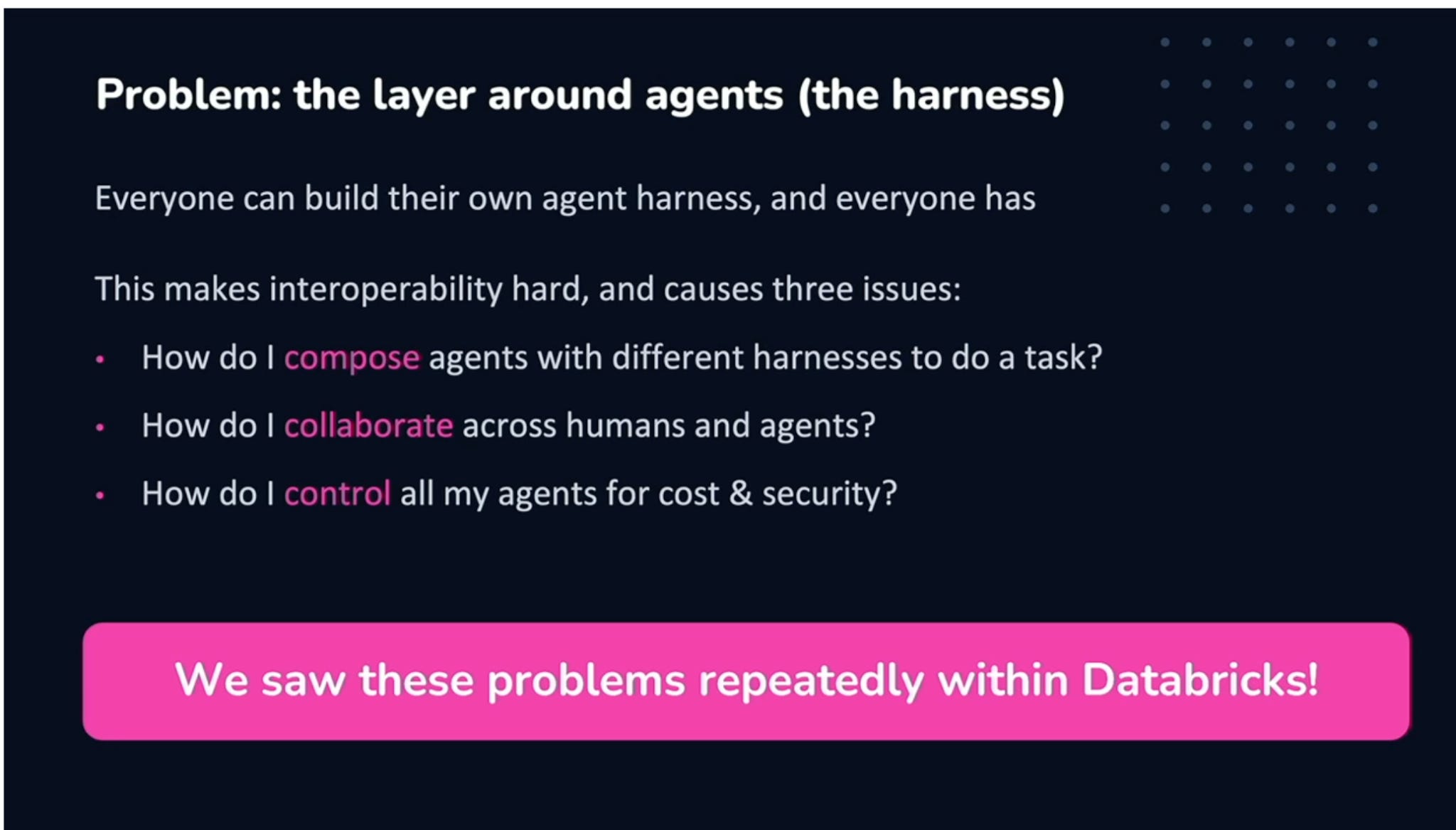
That is the setup for Omnigent, a meta-harness for composition, collaboration, and contextual control across any agent harness or model. The live demo was genuinely cool: switching between Claude and Codex mid-session, running a multi-agent supervisor, bringing in a live remote collaborator, and tying the whole thing to enforced cost policies on a per-task basis.
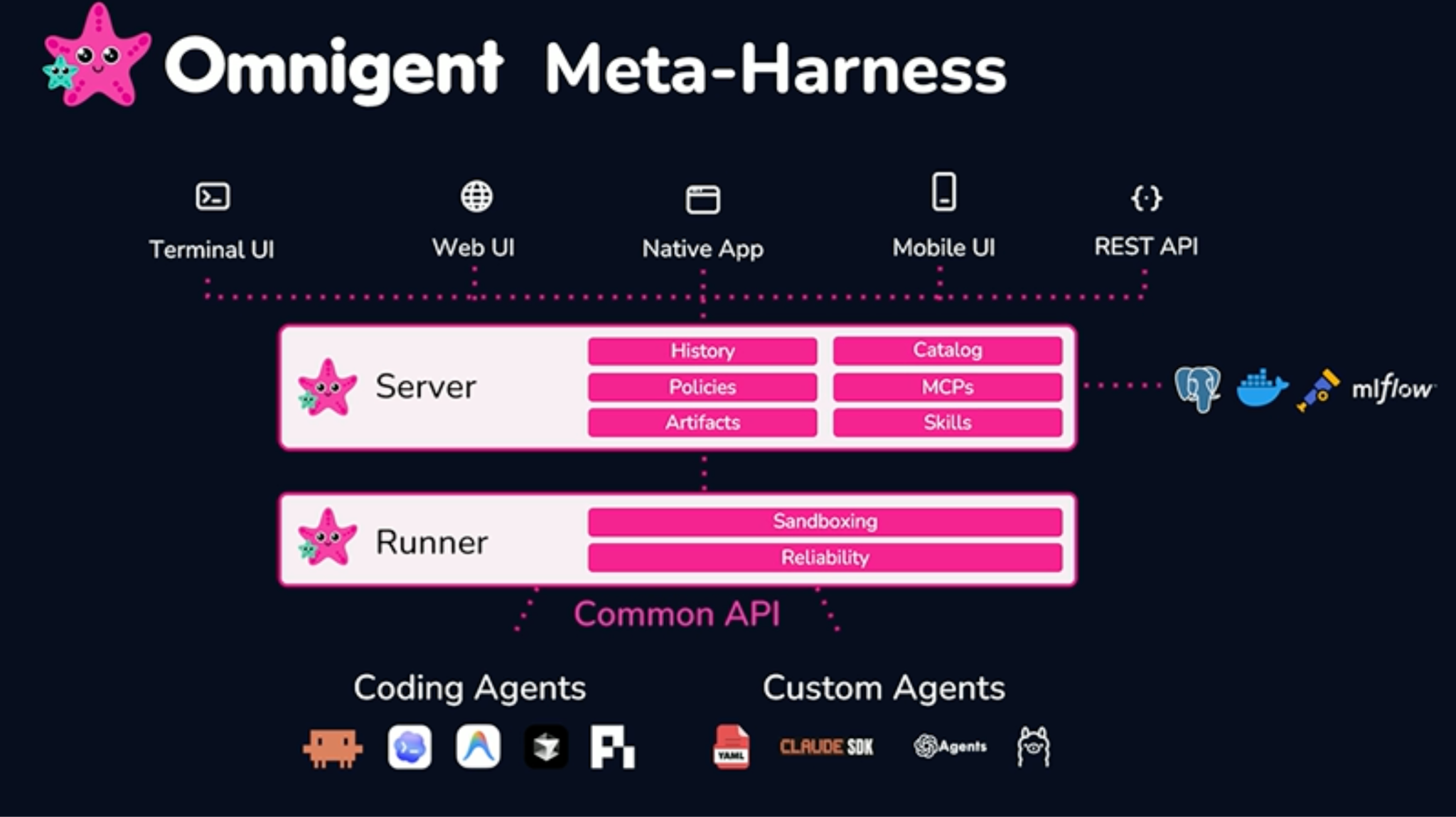
I don’t know yet how much this picks up or how broad the support ends up being. But as a concept, it’s solving a problem of stitching different models and tools together by hand because no one tool does everything well. Worth watching.
The Bottom Line
Context and Governance are in service of getting work done. We say this at Snowflake Summit. We are seeing this at Databricks Summit. The industry is slowly admitting that data was never the point. Work was always the point. Glad more of us are starting to say it out loud.
Good stuff Juan. Was waiting for this. Was there all week, and took plenty of notes. Your four are key takes are on point from my humble perspective, and in common with mine. The verticals (especially CustomerLake, and “infinity campaigns” - leveraging the deep technical upgrades you mentioned) say something. Agreed. Also staying away from the “ontology” (quoted for a reason) topics - I expect (maybe optimistically) features will be coming, for those customers who actually care, and want to steer and govern theirs. Absolutely loved the Omnigent keynote spot - for its entertainment factor, clear governance angle, and collaborative contributions.
One of the best quotes from Juan - “The moment your business logic, your semantics, and your context get built on top of any one platform, you’ve made a much deeper commitment than your storage format.” <- #this
Thank you. Was a defining week for me. Glad you saw some of the same.
Cheers
Thanks for takeaways as always.
Agree; do “not” understand how popularity page ranking is an ontology to disambiguate meaning from different data sources/formats, different human knowledge and/or nuanced situations.