ServiceNow Is Joining Open Semantic Interchange (OSI): My Personal Perspective
A bit of history and why I'm excited

I’m excited to announce that ServiceNow is joining the Open Semantic Interchange (OSI) initiative. I want to share from my personal perspective why this matters, what it means for the industry, and an honest take on where we are and where we still need to go.

But first, a little context.
Back to Snowflake Summit 2023
Three years ago, I was at Snowflake Summit and talking to product folks about the need to invest in semantics and knowledge graphs. The reaction was polite but skeptical. Most people believed that LLMs were going to figure it out: give the model enough training data, fine-tune it, and it would learn to write the right SQL against your database. Problem solved.
I disagreed.
The counterargument at the time was: Do you have a benchmark that shows evidence of the value?
No we didn’t. But as a group of scientists, we know we could do this work. The data.world AI Lab team kicked off the research to understand to what extent knowledge graphs could improve the accuracy of question answering using LLMs over relational databases. Our research result presented in the paper “A Benchmark to Understand the Role of Knowledge Graphs on Large Language Model’s Accuracy for Question Answering on Enterprise SQL Databases” was one of the first to rigorously demonstrate the accuracy gap between LLMs querying raw data versus LLMs equipped with an ontology and knowledge graph. That accuracy increase was 3X at that time.
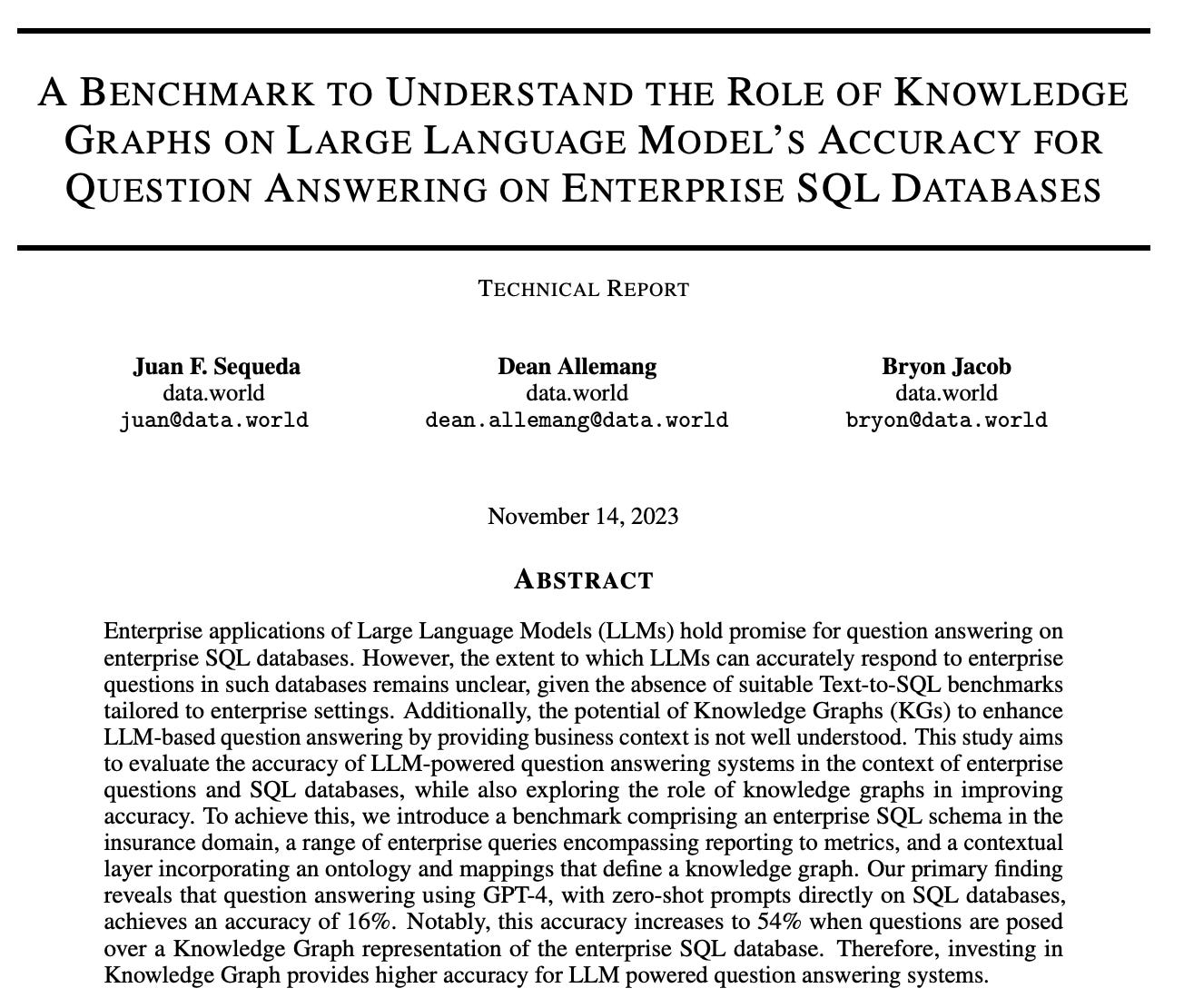
When we announced our results, it went viral and was picked up by many vendors.
That benchmark, which we published in 2023, helped shift the conversation. It wasn’t just us saying “semantics matter”, we had evidence that without them, AI systems fundamentally misunderstand your business. We continued our research and showed how further leveraging ontologies increases the accuracy, in our paper “Increasing the LLM Accuracy for Question Answering: Ontologies to the Rescue!”
That work, and the decades of foundational work done by people like my colleagues Dean Allemang, Bryon Jacob and many others in the knowledge graph and ontology space long before AI became a household word, is part of why I feel a deep sense of pride and responsibility in ServiceNow now participating in OSI.
Semantics is the DNA of your Business
I’m fortunate to speak to hundreds of customers, and even the customers who are still early in their AI journey are landing on the same realization: the semantics of their business (the definitions, the context, the meaning behind the numbers) are the DNA of their organization. And frontier models don’t come pre-loaded with that DNA. They’ve never attended your strategy meetings. They don’t know what “revenue” means in your context versus your competitor’s. They don’t know which KPI drives which decision.
You have to give them that context. And if the way you define that context isn’t standardized and open from the beginning, you are going to pay a significant tax on vendor lock-in, and that is a concern customers have from the beginning.
Two Different Things People Are Conflating
I want to make an important distinction that I think is getting lost in the hype. There are two separate, but related, mandates here:
1. Semantic interoperability as infrastructure. This is the work of defining your business concepts, your metrics, your dimensions, your business processes, and your decision logic in a way that is open, portable, and machine-readable. This work needs to happen regardless of AI agents. It’s foundational. It’s about ensuring that when any system (AI or otherwise) touches your business data, operational or analytical, and it operates from the same shared understanding.
2. Semantic context for AI agents. This is what’s driving all the attention right now. AI agents need to understand the context of the business to act on your behalf. They are consumers of the semantics. This is a powerful, urgent use case, and it’s creating the organizational incentive and funding to finally do the foundational work.
The risk I’m seeing is that organizations are building semantics purely to feed their current AI agent use case, without thinking about the semantic interoperability of their operational and analytical infrastructure. If you only do the former without appreciating the latter, you’ll build something brittle.
The AI agent incentive is real. But understand what you’re actually building. I have an upcoming rant on this topic so stay tuned.
What OSI Represents
The Open Semantic Interchange is a collaborative and open initiative to standardize how semantic models are exchanged across tools: BI platforms, AI systems, data platforms, all of it. It’s vendor-neutral. It’s built in the open. And it’s gaining serious industry momentum. What excites me is that the industry is finally aligned around the need for it
And for those of us who have been speaking the language of knowledge graphs and ontologies and pinging me about how OSI relates to the broader semantic web and W3C standards (i.e. RDF/OWL/SHACL), that’s a real conversation worth having. OSI has started at the metrics and BI layer, and has started to connect it upward to richer ontological frameworks. I’m excited to contribute here.
Where to Start Without Boiling the Ocean
The honest and “obvious” advice I give everyone: start small and think big. Do not walk in on day one and try to model your entire enterprise ontology. That path leads to nowhere.
Start with what’s closest to your analytics layer:
Define the semantics for your data lake and data warehouse
Build out your metric and BI semantic definitions
Recognize that your dimensions are likely already a taxonomy
Establish clear governance around these definitions early
That’s your first real win. And from there, you expand gradually and iteratively, toward richer logic, rules, constraints, business process modeling, decision logic, and eventually the fuller picture of how your organization operates and how AI can understand it.
Final Thought
Twenty years in, watching what was once a niche academic and enterprise architecture conversation become a top-of-mind business priority is humbling. It’s a reminder that the people who do this work before the hype cycle arrives are the ones who make the hype cycle meaningful.
Thrilled for ServiceNow to be part of OSI. More excited to see what we build together.
See the ServiceNow blog for more details: https://www.servicenow.com/workflow/news/servicenow-joins-open-semantic-interchange.html